skip to main | skip to sidebar

Saturday, March 16, 2013

Futuristic simulation of OLED technology.

She had done it! Dr. Brittnee Veldman has managed to incorporate LEGOs into her new research project.

With a blend of materials chemistry, physics, and electrical engineering, Dr. Veldman is working on a new way to synthesize high-dielectric, nano-composite materials for use in flexible transistors. What does that string of complex science terms mean? Well, Dr. Veldman is trying to develop a way to make anything with a LED screen, from televisions to computer screens and even cell phones, as flexible as what we observe in projection screen material. Eventually, televisions will be shoved into poster tubes and hung on the walls with thumbtacks and desktop monitors will be rolled open when in use!


Specifically, Dr. Veldman is working towards organic electronics over our traditional inorganic electronics we encounter today because these organic electronics have synthetic diversity, they are light weight, flexible, inexpensive, and can be made into very large screens as opposed to the breakable and heavy metal-based ones.

Student-made Spin Coater
In order to produce these flexible organic LED (OLED) screens, there needs to be an organic field-effect transistor (OFET) to handle the malleability of these displays. A field-effect transistor is an electrical switch that uses electric fields to control the shape and conductivity of a channel in electronics. An OFET is a field-effect transistor that is made from organic materials. In order for these OFET’s to work, they need insulators to keep the current in the channel and these insulators have to be compatible with the OFETs.

Ideally, an OFET compatible insulator would have high capacitance (ability to keep the electrical charge within the system), be inexpensive as well as simple in production, and have consistent morphology and flexibility. The current materials used as insulators are successful in all but one of those requirements. Dr. Veldman is currently working, yes on the CSUCI campus, to produce an insulator that rises above all others.

By an intricate process of chemical reactions, that I am not at liberty to release, and trust in the laws of chemistry and physics, Dr. Veldman is hoping to synthesize a composite insulator that has a high capacitance, is easy to produce, and is scalable to large areas.

Aside from generating a large piece of the puzzle that stands between me and my television that can be rolled up for transport, Dr. Veldman is further working towards developing the mechanical instruments used in her experiments herself, with assistance from several CSUCI students, of course.

Student-made Dip Coater
There are two possible ways to apply this new insulator to the substrate used in OFETs: spin and dip coating. Spin coating is the process of putting a small amount of the insulator onto a disc and spinning that disc at high speeds to obtain a desired thickness and surface area of the insulator, this works almost like those tie-dye splatter paint spinner things used in the 90’s or a pottery wheel used in ceramics (depending on when you were born, one metaphor will make more sense than the other). Dip coating is when a sheet is dipped or dragged through the insulation substance in order to coat the sheet. THIS IS WHERE THE LEGOS COME IN! Dr. Veldman is utilizing LEGO Mindstorms kits to produce the dip coater to be used in her research project. I just hope no one steps on the LEGO blocks!

Dr. Veldman is working to better the technology we interact with in our every day routines, saving money by producing her own techniques, and I cannot wait until I am able to drop my iPhone without worrying about the glass shattering. 

Friday, February 22, 2013


The Three Drunk Mice 
Alcohol consumption seems to be the topic on every scientist’s minds these past few weeks and who am I to stop the momentum? 

Alcoholic mice have been undergoing rehabilitation at the University of California, Los Angeles under the extended care of a team looking to not only sober them up, but decrease their liver damage.

The UCLA team has discovered an enzyme complex that can be used to sober up drunken mice as discussed in an article released online by Nature Nanotechnology this past Sunday. Not only is this a trailblazing idea for drinkers and alcoholics alike, but also there is an application to future use of these techniques with other diseases.

The enzymes that break down alcohol in the body can only break down the ethanol for so long. When these enzymes cannot keep up with the shots lined up at the bar, that is when you start to feel drunk. Such enzymes are alcohol dehydrogenase, cytochrome P450, and catalase.

In the context of this study, a super enzyme (nanocomplex) of catalase and alcohol oxidase was made by using the characteristics known of these enzymes to string them together. This known characteristic is called an “inhibitor DNA complex” and it has been created to have an inhibitor DNA complex per each enzyme on it. What this inhibitor DNA complex does, is bind the desired enzymes to where they normally would in the body so that they stick to the strand of DNA. Then these bound enzymes and inhibitor DNA complexes are wrapped in a polymer coating to keep them stable and safe. To complete this production of a nanocomplex, the inhibitor DNA complexes are removed from the enzymes. Now, we have an active, ready-to-go nanocomplex to be introduced into the body for whichever purpose it was intended. 


An illustration of the enzyme nanocomplex synthesis.
Regardless of the complicated process required to make these nanocomplexes, the ones developed in this research project were proven to lower the BAC and ALT (alanine transaminase) levels in intoxicated mice. Although the increased breakdown of alcohol in the body is important for individuals trying to sober up, the decreased amount of ALT present in the body is what is particularly interesting. ALT is an enzyme biomarker for liver disease. By “enzyme biomarker”, I mean a clue for scientists to determine whether or not there is damage in the liver occurring. When taken with alcohol, this nanocomplex lowers the amount of ALT present after alcohol consumption, which means it can help prevent liver disease.

Now that scientists have proven they can sober up mice, they are moving on to show it works identically in humans and, more importantly, apply this nanocomplex technology to other diseases. Yunfeng Lu, one of the leading professors for this research project, has begun investigating whether or not male pattern baldness can be cured with a special tailored enzyme nanocomplex.

Cancer, type-1 diabetes, Alzheimer’s? The possibilities are endless with this new science and I cannot wait to see how far nanocomplexes are taken in the field of medicine.

Once again science, you rock.

Kayte Bataille 

Monday, February 4, 2013


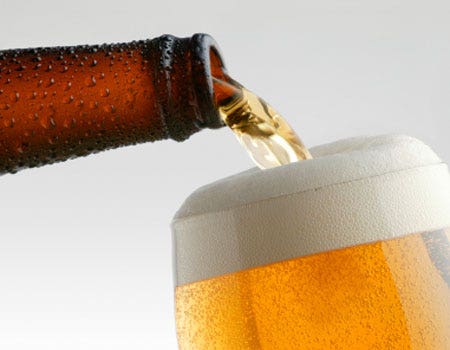
Finally, science has figured out how to incorporate drinking into our health! Werner Kaminsky, a research associate professor of chemistry at the University of Washington, has reportedly stumbled upon a new finding relating some characteristics of beer to potential pharmaceutical uses, as published in the journal Angewandte Chemie International Edition this January.

Humulones, the component of hops that distinguishes the taste of different beers, undergo molecular rearrangements during the brewing process to yield a five-carbon ring with two side chains. The side chains can be placed in four different positions around the ring, which affects the molecule’s ability to interact with surrounding compounds. In December, humulones were shown to be possible protectors against certain infections. 

Humulones have a potential in leading production of pharmaceuticals to treat diabetes, certain types of cancer, and other ailments. The way these humulones interact with their surroundings, as well as each other, explains the mechanisms behind specific treatments in the medical field as well as disastrous results that pharmaceuticals can have to the human body.

Beer, by itself, does not have the same potential
medical benefits as mentioned in the article.
 
Some of you might recall the drug thalidomide (those of you who took Drug Discovery and Development). This substance was sold in Europe from 1957 to 1962 to treat morning sickness in pregnant women. While the drug did stop morning sickness, thalidomide caused severe birth defects in women who used the drug and was banned soon after. The isotope of thalidomide that harmed unborn children was different than the one that just cured morning sickness. The same goes for humulones; certain isotopes of humulones are toxic while others are beneficial.  Kaminsky compares the catastrophic effects of certain strains of thalidomide to what he has observed in humulones.

In order to determine which isotopes were created during specific brewing processes, Kaminsky received samples of acids that were collected and purified by coauthors Jan Urban, Clinton Dahlberg, and Brian Carroll from KinDex Theraputics. The humulones in those acids were crystallized and observed by X-ray crystallography to define their molecular structure.

“Some of the compounds have been shown to affect specific illnesses”, Kaminsky said, “while some with a slight difference in the arrangement of carbon atoms have been ineffective.”

Maybe one day we will see a set of pharmaceutical drugs that are derived from this process Kaminsky is researching. I don’t know about you, but I would love to tell people that beer is the cure to my sickness.

Once again science, you rule.

-Kayte Bataille 

Thursday, November 15, 2012


A couple of the "Falcon Tube" rockets used
during the chemistry experiments
On the November 3rd, 2012, CSU Channel Islands had its fourth Science Carnival for the local kids in grades K-8 and their families. As it has since 2009, the science carnival displays science to the attendees as a fun and applicable subject to study during their potential undergraduate studies. The goal of the science carnival is to help local students find a passion and interest in the sciences, no matter which discipline it may be.

Dr. Phil Hampton founded the science carnival in 2009 with hopes of creating a community outreach program for the young students attending school within Ventura County. In addition to igniting a passion for science, Dr. Hampton hoped to create an event that would provide a hands-on experience for children and their families that was fun, free of price, and full of excitement. Dr. Hampton has succeeded tremendously.

This year, there were a large amount of exciting and interesting experiments to witness. From looking at animal bones to slime, and frozen ice cream to different colored flames, the science carnival was able to create a diverse learning environment for students of all ages.
Aurora Ginzburg lighting her hands
on fire with propane bubbles

One of the experiments involved lighting a student’s hands on fire. The experiment involved propane, water, bubbles, and fire. A container filled with propane had a hose in it that caused the propane to form bubbles at the top of the liquid. The student then put her hands in a bucket of water and then scooped up the bubbles. Channel Islands (CI) student Aurora Ginzburg took a lighter and set the bubbles aflame, causing a beautiful ball of fire to light up within her hands. The propane burns faster and at a lower temperature than water does, which explains why coating your hands with water makes sure that your hands don’t burn along with the propane bubbles you are holding.

The magnesium metal creating a bright
spectacle within the dry ice blocks
A second experiment involved burning magnesium metal in dry ice. A couple pieces of magnesium metal were put between two pieces of dry ice. The magnesium was lit with a torch and the children’s eyes began to widen. The bright spectacle caused by this combustion results in magnesium oxide and carbon powder. The oxidation and combustion reaction caused by the burning magnesium reacts with the oxygen in the dry ice to result with carbon powder left within the two slabs of dry ice.

CSU Channel Islands’ chemistry professor, Dr. Brittnee Veldman, put one of the more dramatic experiments on. She spent a majority of the carnival lying on a bed of nails for all the visitors to see. She started by throwing an apple at the bed of nails to show how the differences in weight displacement on the bed affects the objects differently. When an object is subjected to the bed with only a small amount of the surface area being exposed to the nails, an unfortunate effect is observed: a pierced apple. On the other hand, when a person lies down on the bed with his or her weight completely dispersed, as Dr. Veldman did, the individual is unharmed. The person can actually have a cinder block broken on his or her chest while lying on the bed of nails.
A cinder block being broken on Dr. Veldman's chest
as she lies on the bed of nails. 

The three mentioned experiments were not the only events shown during the science carnival. There is nowhere but up for these experiments to go with each science carnival that passes. I can only encourage you to attend next year’s event, for there is only so much that I can describe in written text. You can only see it to believe it.

Once again science, you rule!
Kayte Bataille 

Wednesday, October 10, 2012


Ladies and Gentleman, the winners have been announced!

Robert J. Lefkowitz (left) and Brian K. Kobilka (right)
At 2:30AM this morning in California, the recipients of the Nobel Prize in Chemistry were called and informed of their accomplishments. Robert J. Lefkowitz, 69, and Brian K. Kobilka, 57, have discovered the molecular workings and structures of G protein-coupled receptors (GPCRs). GPCRs are a family of proteins that have been discovered to be the transmitters of critical biological messages for functions such as vision, smell, taste, and neurotransmission.

The two men set out on their scientific journey in an attempt to understand the biological processes that occur during a body’s production of stress hormones, such as adrenaline. Science already uncovered what happens to a person when the hormones are produced; a receptor is bound by the hormone and then a person experiences focused vision, quickened breathing, diverting blood from the less important body systems etc. The groundbreaking aspect of Lefkowitz and Kobilka’s findings is that the nature of the receptors for these hormones are now known.

Lefkowitz first traced the signaling of these receptors in the 1970s with radioactive blocking agents attached to hormones. By marking the hormones, Lefkowitz was able to follow where they attached in the body and observe the activities of the receptors they attached to. With much effort, Dr. Lefkowitz was able to identify the receptor proteins and prove they were specific molecules.

In the 1980s, Lefkowitz’s group at Duke University, which Kobilka was a part of, found the gene that actually produced one of the protein receptors. The group saw that the shape of the protein had many long spirals that wove through the cell membrane exactly seven times.

3D image of rhodopsin.
Realizing that the receptor he discovered had the same characteristic seven helicies as another receptor that had been found in the retina, in this case the light receptor rhodopsin, Lefkowitz and his team set out to find several other similar receptors that were found to be in a family of receptors, called the G protein-coupled receptors. Today, about a thousand of these GPCRs are known. They reside on the surface of cells and react to a host of hormones and neurotransmitters. Dr. Kobilka moved to Stanford and progressed to determine the three-dimensional structure of the GPCRs, which involved the utilization of x-ray crystallography.
“We hope by knowing the three-dimensional structure we might be able to develop more selective drugs and more effective drugs,” Dr. Kobilka said. The ultimate goal with all this new information is to refine drug design. Many drug molecules attach to cells, not only at the intended target, but also to other receptors.  This may help eliminate those unwanted side effects that one experiences when taking certain drugs.