skip to main | skip to sidebar

Thursday, February 16, 2012

CI students from left to right
Lorenzo DeSantiago, Camille Peredo, Devon Dally,
Eric Needleman (from the CSU), Jason Torres, Susan Ly, Claudina Cammack
Photo compliments of the CI Chemistry Department
While some of us may have been feasting on leftover Christmas cookies or savoring our last days of sleeping in before the dawn of a new semester, several CI students including Susan Ly and Lorenzo DeSantiago were busy presenting their research at the CSU Program for Education and Research in Biotechnology (CSUPERB) symposium in Santa Clara over winter break. “It’s cool because you get immersed into everything… all the big companies are there,” said DeSantiago. “You have Google, Yahoo and biotechnology companies are everywhere.”

Ly and DeSantiago are part of a research team led by Dr. Blake Gillespie, associate professor of chemistry at CI. The team is dedicated to studying CusF, a protein found in E. coli, in hopes to better understand what governs protein stability. “We want to understand the basis of ligand-dependent stability,” said Ly. “We are not trying to cure a disease but many diseases arise from protein misfolding.” The team hopes to create a global model for protein stabilization that can be related to other proteins as well as CusF.
CI student Lorenzo DeSantiago 
Photo compliments of the CI Chemistry Department

In addition to allowing undergraduates the opportunity to present their own research, CSUPERB is an excellent place for students to make new connections in their field. “You get to network across different CSUs,” said DeSantiago.

Ly explained that her favorite part of the conference was viewing the other student’s research poster presentations. “It is really interesting to find out about what other students are doing,” said Ly. “Also, it is good practice to try to explain your own research in a way that a person outside your field can understand.”

Both Ly and DeSantiago expressed thanks for the opportunities that have been available to them at CI. “I am incredibly grateful for this research opportunity,” said Ly. “I know if I was at another school I would not be able to do the research I am doing now.” Interested parties will have a chance to check out Ly and DeSantiago’s project among other current research happenings at the 2012 Southern California Undergraduate Research Conference in Chemistry and Biochemistry (SCURCCB) that will take place in April on our very own CI campus.

Tuesday, February 7, 2012

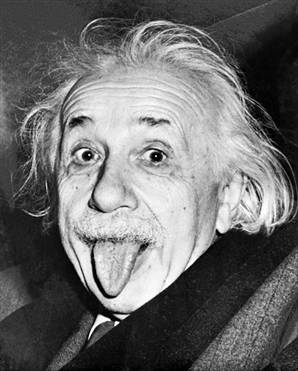
Albert Einstein
In the past decade, suspicions have arisen in the scientific community concerning the uniformity of the constant, alpha, that reflects the strength of electromagnetism in regards to how hydrogen gas absorbs ultraviolet light in space. Alpha seemed to differ throughout the universe based on observations made in the last decade with the Keck Telescope in Hawaii and again in 2010 with the Very Large Telescope in Chile. If confirmed, this idea would challenge Einstein’s equivalence principal, that states that the laws of physics are the same in all parts of the universe, and may lead to wacky new ideas like the existence of other universes and additional dimensions. Some scientists thought this idea was a bit too bizarre to deserve much merit.

Recently, in a study done by teams at the National Centre for Radio Astrophysics in Pune, India and the National Radio Astronomy Observatory in Socorro, New Mexico titled Constraining Fundamental Constant Evolution with HI and OH Lines, that was thought to finally settle the debate, researchers detected the hydroxyl molecule’s emission and absorption of radio waves in a gas cloud 6.7 light years away. The hope was that the radio instruments used, which are capable of taking measurements at 50 to 100 times greater accuracy than in previous experiments to detect hydrogen absorption, would provide evidence of a more conclusive nature regarding these claims.

Unfortunately, researchers came up empty handed. It was the expectation that the emission and absorption lines observed from the hydroxyl molecule would be mirror images of each other. This was not the case in this experiment, which led researchers to believe there was something spoiling their measurements. One possibility is that a second hydroxyl gas cloud lying on the same plane was responsible for the screwy results.

Since gas clouds that carry a hydroxyl signal are hard to come by, possibilities for settling the dispute in the near future are looking grim; however, every gas cloud has a silver lining. Though it may take years, this new promising method may prove useful as new clouds are discovered and examined.

Tuesday, December 13, 2011

Zircon Crystal
Early Earth may not have been the methane-rich reducing soup the scientific community previously believed it to be. Researchers at the Rensselaer Polytechnic Institute uncovered evidence that will force scientists to write a new recipe for the atmospheric conditions of early earth that gave rise to the building blocks of life.
Prior to this study, scientists believed that early Earth consisted of an oxygen deficient atmosphere filled with methane, carbon monoxide, hydrogen sulfide and ammonia. To date, theories of how life began on earth were concocted from these toxic ingredients.

In the paper titled The Oxidation State of Hadean Magmas and Implications for Early Earth’s Atmosphere that was published in the December 1st issue of Nature, researchers reveal that the atmosphere of early Earth may be closer to our current oxygen-rich conditions than previously thought.

The theory that the outgassing of magma released by volcanic activity was responsible for forming early Earth’s atmosphere is widely accepted by most scientists. To determine what gasses the magma was supplying researchers at Rensselaer looked at zircons, minerals contained in the magma that had crystalized into solid rock on Earth’s surface, to provide a glimpse into the past. Zircons, being that they are not destroyed over time like most other minerals, are commonly looked to for clues regarding the history of Earth. In this experiment, researchers used zircons to provide them with a sneak peak into the oxidation states of atmospheric gases by determining the oxidation state of the magmas that created the zircons.

Understanding the conditions that gave rise to life on earth is not only crucial to further our quest for knowledge of our own origin but alters the way we look for potential life on other planets in our universe.

Sunday, November 20, 2011

Atomic Model of a Quazicrystal Surface
Dr. Dan Shechtman, similar to the quazicrystals he discovered, isn’t afraid to be different. Despite years of ridicule and harsh skepticism from his peers, Dr. Shechtman received the Nobel Prize in Chemistry in 2011 for the discovery of quaziperiodic crystals or quazicrystals.

Quazicrystals, unlike conventional crystals, lack symmetry in their ordered atomic structure. Prior to Shechtman’s discovery, it was widely accepted in the scientific community that repetition in atom packing inside crystals was necessary for their very existence. It wasn’t until the morning of April 8th, 1982 that Shechtman would unearth an image that would prompt him to ask the scientific community to follow him down the quazicrystal rabbit hole.

Dan Shechtman Ph.D.
The seemingly impossible image Shechtman exposed was that of a crystal with an arrangement of atoms that were not in repetition, similar to that of aperiodic mosaics. The discovery triggered oodles of uproar causing Shechtman’s own research team to ask him to ask him to leave the group.

Ultimately the scientific community had to re-evaluate their understanding of solid matter as other scientists obtained quazicrystals in the lab as well as discovered them naturally. Quazicrystals may have applications in diesel engines and frying pans but more importantly for use as a reminder that with an inquiring mind questioning the impossible might win you a Nobel Prize.


Monday, November 7, 2011

Yelena Lacey and daughter Alexie explore the
peculiar effects of liquid nitrogen
Over 1000 kids and parents flooded the field at the University Charter Middle School on October 21st for the third annual CI Science Carnival. Eager to learn about science and math in this hands-on Halloween themed event, kids were able to experience the effects of liquid nitrogen while enjoying cotton candy and the bending of light while they munched popcorn. 
Ashley Reyes learns about how fossils are made 
at the “Prints from the Past” demonstration


“Events like the Science Carnival show kids that science and math can be fun,” said Dr. Philip Hampton, coordinator of the Carnival for the past three years. He went on to say that “too often kids are told that these subjects are hard and, as a result, they can get discouraged from viewing themselves as being able to succeed at them.” I’m happy to report that the kids at the carnival were anything but discouraged.
Tori Hoge prepares to launch a marshmallow
using a compressed air gun
Currently, a five-year Department of Education Hispanic Serving Institutions grant funds the Science Carnival. With attendance for the event skyrocketing year after year it is Dr. Hamptons hope that the event will continue to grow and eventually become sustainable though building partnerships within the community.

Theodore Parra stares in awe at the splitting of 
light through his diffraction grating glasses
While some of the science behind the demonstrations and experiments might be difficult for the kids to understand, Dr. Hampton assures that “by being exposed to these subjects in a fun setting, they can also see that while the subjects might be challenging, they can also be incredibly rewarding.” It doesn’t take a mad scientist to know that’s a lesson worth learning.

Friday, October 21, 2011

Ahmed Awad, Ph.D.
Photo Compliments of the 
CI Chemistry Department
Ever wonder what would have happened if Marty McFly didn’t reunite his parents in Back to the Future? He wouldn’t exist of course! Dr. Ahmed Awad and 8 students at CI are on the hunt for ways to best cancer before it exists by developing drugs that specialize in inhibiting gene expression without the use of a DeLorean.

Some drugs target the protein after it has already formed; however, Awad and his team have a very different approach. “Our target is the messenger RNA,” Awad explained. The drugs consist of small segments of nucleic acids called oligonucleotides, which target the messenger RNA in carcinomic cells. The oligonucleotides react with the RNA by Watson-Crick base pairing via two mechanisms. The first mechanism blocks the translation into the protein. The second mechanism activates an enzyme called RNase H, which degrades the RNA/DNA complex.

“Chemical modifications are important to stabilize these drugs,” Awad noted. Reagents must be stabilized against nucleases, enzymes that cause nucleic acids to degrade. Nucleases are capable of degrading injected oligonucleotides within 5 minutes of injection, before the drug can reach its destination.

With any luck the next generation of these gene-inhibiting drugs will succeed in telling cancer to make like a tree, and get outta here.

Monday, October 3, 2011


Solved structure for the M-PMV retroviral protease
University of Washington
From battling asteroids to battling AIDS, video games have come a long way. Using an internet based cooperative game called Fold It, online gamers have managed to solve the structure of an enzyme that has baffled scientists for more than ten years.

Like HIV, Mason-Pfizer monkey virus (M-PMV) causes AIDS in monkeys and apes. A M-PMV retroviral protease, a protein-cutting enzyme, is a key element for the spread of the virus in rhesus monkeys. After numerous attempts with molecular replacement techniques and years of frustration, scientists asked for the help from the Fold It gaming community.

Fold it is designed to utilize the special reasoning skills of warm blooded human beings to find the lowest energy state for a given molecule. It works by assigning points to players as they discover lower energy states for structures within a specified framework that reflects the laws of nature and chemistry. In this case a team of Fold It players solved the structure in less than 10 days time. According to a paper titled Crystal Structure of a Monomeric Retroviral Protease Solved by Protein Folding Game Players that was published in the September 18th, 2011 edition of Nature Structural & Molecular Biology, the structure discovered was “of sufficient quality for successful molecular replacement and subsequent structure determination.”

As a former Tetris addict, I am excited at the prospect that the worlds of video games and science are becoming complimentary. As long as there are tasks and puzzles that human brains can tackle and computer processors cannot there will be a place for citizen science. Who knew that solving proteins could be as fun as saving Princess Peach?